Grafenegg Festival and many beautiful memories
Tomorrow, the Danish National Symphony Orchestra will perform a concert under my direction at the wonderful Grafenegg Festival in Austria (Nielsen, Beethoven – with my friend Rudolf Buchbinder – and Brahms/Schönberg). I have been to the Grafenegg Festival several times, including once with the DNSO from Copenhagen and a couple of times with my beloved Tonkünstler Orchestra.
Grafenegg, with its romantic (unfortunately fake Gothic) castle and the still-authentic “Grafenegger Schlosstaverne” (now a Mörwald Hotel Restaurant), holds a special, important place in my life.
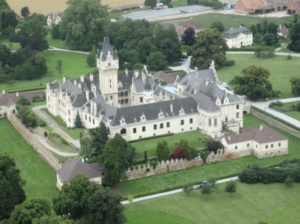
In 1979, when I was twenty, I applied to participate in a masterclass led by Adam Harasiewicz. Mr. Harasiewicz, who is now all but forgotten, won the Chopin Competition in 1955, and the masterclass focused on Chopin interpretation. I had completed my diploma in piano at the Paganini-Conservatorium in Genoa the year before, in 1978, and I was still pursuing a career as a pianist (my first contacts with singers, which led to a change in my goals, i.e., wanting to become a conductor, had started in 1979 and were deepened the next year, 1980, especially through meeting Leyla Gencer and Luciana Serra).
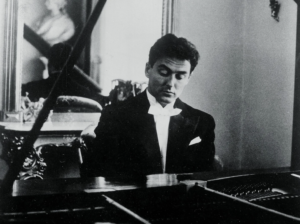
Adam Harasiewicz
The Summer of 1979 was my first experience outside of Italy, aside from studying with Aldo Ciccolini in Orange in 1978, and I was very nervous but also very excited.
Mr. Harasiewicz was very sweet and kind during that Masterclass. By contrast, my (and, in general, all students’) encounters with another teacher at that Masterclass at Schloss Grafenegg, Ms. Halina Czerny-Stefanska (who won the Chopin competition in Warsaw in 1949), were less pleasant and less kind. She was an excellent teacher, but extremely strict.
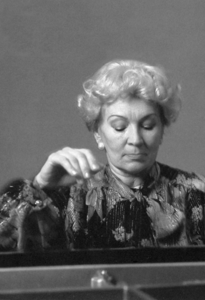
Halina Czerny-Stefanska
I had prepared Chopin’s h-moll Sonata for this course, and I could work on it with both teachers, Mr. Harasiewicz and Ms. Czerny-Stefanska. They, of course, had different, and at times opposing, opinions about its interpretation, but I could benefit musically from both of them. Unfortunately, another participant, a young Japanese girl, had also brought the same piece to the course, and she was without a doubt better than me. Nevertheless, both teachers wanted me to play at the final students’ concert, so I had to prepare something different in a week. I chose Chopin’s g-moll Ballade, but since I had never studied it, I had to practice day and night.
We, the students, all lived in the Grafenegger Schlosstaverne, and the organizer of the Masterclass, the wonderful Dr. Grossberger (together with the Austrian Chopin Society, then led by Dr. Prilisauer), allowed us to study at night in the Castle. We had a key (a real, big old key) to open the main door, and we could practice and play whenever we wanted. A real paradise for pianists.
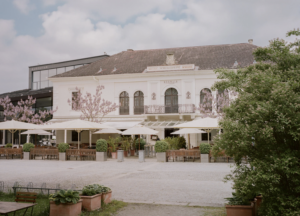
Today, I am at the Grafenegger Schlosstaverne in the very room (Room 7) I stayed in during my 1979 visit. It brings back many beautiful memories: my “former” life as a pianist, many friendships I made during the Masterclass, my first contact with Austria and its musical life – I later spent many years in Austria, studying in Graz and living there, and later in Vienna – and a musical “awakening,” working with great artists and teachers.
At that time, Grafenegg was very isolated, a forgotten castle with a small cultural life. Now, it is one of the major European festivals.
I am fortunate to have experienced Grafenegg at its beginning and now.
