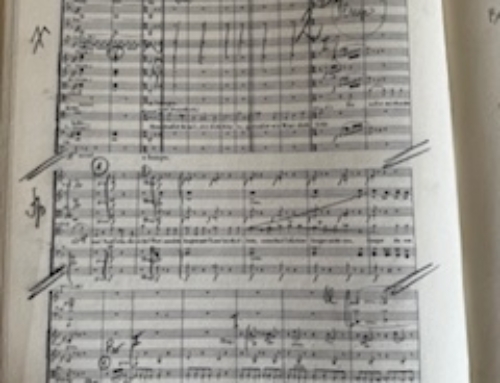
It was truly incredible to me that one of the most prolific American composers, and at the same time one of the most performed in the fifties and sixties of the last century, has almost completely disappeared from being programmed by American orchestras: Alan Hovhaness.
I am rediscovering Alan Hovhaness because his music seems to speak with a particular clarity to our own time. There is in it a serenity, a purity of line, and an almost ritual sense of stillness that sets him apart from much of the music written around him.
What fascinates me most is how Hovhaness brings together distinct musical worlds. His language is unmistakably American, yet it is deeply informed by Armenian and broader Eastern traditions: modal writing, long melodic lines, drones, bells, chant-like gestures, and a conception of time that is often contemplative rather than dramatic. He did not simply borrow exotic colors; he created a genuine synthesis of East and West.
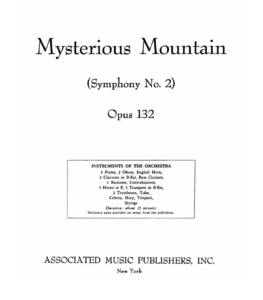
Listening to Mysterious Mountain today, one can also hear something remarkably prophetic in his music. Its spaciousness, repetition, luminous harmonies, and sense of spiritual contemplation seem to anticipate qualities later associated with minimalism, ambient music, and even what came to be called “New Age” music—although Hovhaness’s language has far greater structural and spiritual depth than most actual “New Age” labeled works.
Perhaps this is why his music deserves to be heard again with fresh ears. Hovhaness offers neither irony nor complexity for its own sake. Instead, he seeks simplicity, transcendence, and a direct relationship among sound, nature, and the spiritual imagination. For me, returning to his music today feels less like reviving a forgotten composer than like discovering how modern he has remained.