Kathrin Brunner interviews Fabio Luisi about the Opera “Cardillac” by Paul Hindemith, currently at the Zurich Opera
Fabio Luisi, in Zurich, you’re conducting your third new production of “Cardillac,” following productions in Dresden and Florence. What fascinates you about this piece?
It’s this very unique musical language. “Cardillac” isn’t an opera that draws its power from the drama of the text or the situations. Instead, it’s genuinely a musical opera: the music carries everything; it develops independently. It doesn’t illustrate or explain. Hindemith deliberately moves away from Wagner’s idea of a through-composed music drama, leaning toward older forms. There are clearly self-contained numbers like arias, duets, and scenes with distinct endings. Hindemith works with individual musical blocks, with hardly any motivic references. He emphasizes pure musical form. That’s a clear aesthetic statement. That might sound very abstract. Is this music also emotionally detached? Hindemith actually aimed not to evoke emotions, especially in this opera. In later works, such as “Mathis der Maler,” he moved away from this approach to some extent. In “Cardillac,” he only partly achieved this goal — but I won’t judge him for it. Some of the most beautiful moments in this opera sound distinctly romantic or even impressionistic: the lady’s song, for example, or the duet between daughter and father. The latter is also strictly composed as a fugato… and both sing completely different texts… This, in turn, is influenced by the pre-Wagner era and the tradition of 19th-century Italian opera. Maybe the emotion in this piece is simply conveyed differently through the many rhythmic accents in the score. To me, this rhythm signifies the piece’s modernity and connects it to its era. We are in the 1920s: jazz is spreading across Europe, and you can sense the age of big cities, machines, and railways. These pounding rhythms, along with the instrumentation featuring the saxophone, closely associated with Cardillac’s character, clearly place the piece in the Weimar Republic era, the period between the wars. “Cardillac” is a revolutionary opera. It doesn’t surprise me that the Nazis later had issues with Hindemith.
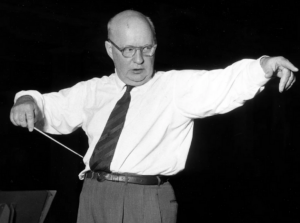
Paul Hindemith
The orchestra in “Cardillac” has an unusual instrumentation. Where does this sonic concept come from?
It has a lot to do with Hindemith’s close relationship with Kurt Weill. The two even co-wrote an opera later, “Lindberghflug.” The “Cardillac” orchestra is relatively small and particularly emphasizes wind instruments—almost like a big band with some strings, plus piano and a lot of percussion. Is there a general mood for you in this score? The story of a murderous goldsmith is inherently dark… There isn’t a single, unified mood here. This is partly because Hindemith mainly links individual lines rather than creating truly expansive soundscapes. However, the low instruments play a key role. The string section alone—six violins and four double basses—is anything but perfectly balanced. Add to that the tuba, bass clarinet, and English horn, all from the bass family. In contrast, brighter colors appear, especially at the end when Cardillac confesses. Suddenly, the flute and piccolo come into play. This feels like a glimpse into Cardillac’s idealized, secluded world, into which no one else is allowed entry. You can definitely hear both the light and dark sides of Cardillac. The other characters are intentionally less individually developed musically. They serve as types, fulfilling specific functions: the daughter or the lady, whose beautiful aria is almost overwhelmed by too much Art Deco, or the cavalier, as an ironic parody of a tenor hero. This latter character, by the way, has nothing to do with a true cavalier but is a reckless daredevil of the worst kind.
A unique feature of this opera is the peculiar love scene between the lady and the cavalier: he presents her with the coveted jewel and is subsequently murdered by Cardillac.
It is a purely instrumental scene in which, as in a silent film, detailed stage directions specify what happens on stage alongside the music. This pantomime—as Hindemith himself calls it—is a magnificent and sometimes ironic moment. It marks Hindemith’s most radical departure from traditional music, drama, and vividly embodies his principle of stylization. The love scene between the lady and the cavalier, which might be sung as a duet in other operas, is here, in a sense, “muted.” Formally, this piece is a kind of canonized divertimento in ABA form. At first, only a few instruments are heard. Two flutes circle each other, lose themselves as if in a labyrinth, and then entwine again. The music, in parallel with increasingly dramatic stage directions, takes on increasingly grotesque qualities until it abruptly halts, almost like a question mark. During the general pause, the murder occurs. The full orchestra returns and crashes into an abyss.
How does Hindemith shape the tonal space in “Cardillac”?
It’s a unique, complex tonal landscape that Hindemith employs in “Cardillac.” He utilizes techniques of multitonality. We see this in the works of Stravinsky and Debussy as well; it’s not revolutionary in itself, but Hindemith makes it highly distinctive. He’s a composer you always recognize immediately; he has an extremely rigorous musical language. He’s often compared to Max Reger. Hindemith himself mentioned Reger, saying he couldn’t imagine his music without him. However, Reger, unlike Hindemith, remains closely tied to late Romanticism—Hindemith is a 20th-century composer. He’s a composer you can instantly recognize; his musical language is very rigorous.
How free is a conductor in such a complex, detailed score as “Cardillac”?
Is there room for interpretation?
I generally avoid using the term “interpretation” in relation to my profession. I see myself as a performing musician; the score is my top priority. Since the form of this opera is very strictly defined, there is limited room for interpretation. However, when the music departs from the “New Objectivity” style, I intentionally allow myself a hint of Romanticism. These deviations are part of this opera—and they need to be made audible.
As a conductor, are you familiar with the “Cardillac” syndrome? You have to detach yourself from your art every night…?
We conductors are not creators but performers. Of course, we add energy, but the work doesn’t belong to us. Still, I understand well when composers or visual artists develop such a close connection with their works that they struggle to let go. I’ve seen this often with several contemporary composers. Some insist on having complete control over the performance. But music only truly comes alive during the performance, not in the composer’s mind. It depends on the musicians’ artistic personalities, who are not machines and don’t just play by the book. It depends on everyone collaborating—the space, the performers, and the audience. Each performance, therefore, creates something new.
