Why Alexander Zemlinsky’s The Little Mermaid Is Not a Soundtrack
I recently watched an interview with a colleague, a talented and knowledgeable conductor, who claimed that Zemlinsky’s The Little Mermaid was comparable to the works of Korngold, who composed extensive film music during his exile in Hollywood and became known as the first great composer of this genre. The colleague considered Zemlinsky’s symphonic poem to be a predecessor of the modern soundtrack because it depicts every part of Andersen’s fairy tale through music, illustrating each scene.
While I highly respect my colleague, I found this statement very disappointing because I believe Zemlinsky’s The Little Mermaid is the complete opposite of a soundtrack. Of course, a soundtrack can serve as a source of inspiration and help us understand the action of a movie by heightening tension, supporting pacing, or emphasizing characters. Think of Maurice Jarre’s unforgettable music for Doctor Zhivago or Lawrence of Arabia, John Williams’ extraordinary scores for the Star Wars and Harry Potter films, or Hans Zimmer’s music for Gladiator or Interstellar.
Zemlinsky starts from a very different premise. His goal isn’t merely to describe an action or situation but to explain it: like Richard Wagner’s operas, his music not only follows the story but also allows us to enter the emotional world of the Little Mermaid, helping us understand her intentions, motives, and thoughts. In this way, he follows Andersen in his fairy tale: the story isn’t just about tracking a plot but about exploring the protagonist’s inner journey, celebrating her personality and her pursuit of a unique personal identity beyond conventional patterns—the dichotomy of “human” and “non-human,” and the quest for a soul—culminating in her transcending these and ascending to a higher realm.
The Little Mermaid has no name: she searches for one, transcends it, and becomes a spirit of the air.
In this, Zemlinsky, with this masterpiece, does not present us with a precursor to Hollywood soundtracks but with one of the defining achievements of the Wagnerian symphonic poem. In this inward exploration, the outer story or plot serves merely as a pretext. Just as Schönberg takes us into the psychoanalytic depths of Pelléas et Mélisande, and Richard Strauss surprises us with the emotional intimacy and wordless wonder of reaching the summit of a mountain in his Alpensinfonie, Zemlinsky accompanies the Little Mermaid’s search for self by depicting not her actions, but her feelings and sensations, and therein lies his greatness.
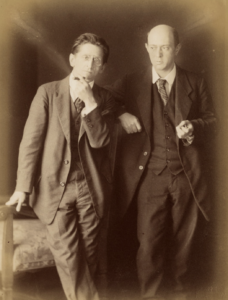
Zemlinsky with Schönberg in Prague, 1917
Perché “La Sirenetta” di Alexander Zemlinsky non è un soundtrack.
Ho visto di recente un’intervista di un collega, direttore d’orchestra, peraltro bravo e preparato, che affermava che “La Sirenetta” di Zemlinsky fosse paragonabile alle opere di Korngold, che durante il suo esilio a Hollywood scrisse molta musica per il cinema, passando alla storia come il primo grande compositore di questo genere.
Il collega considerava Zemlinsky ed il suo poema sinfonico come i predecessori del soundtrack moderno, perché descrive ogni passaggio della favola di Andersen tramite la musica, illustrando ogni scena.
Stimando molto il mio collega, sono rimasto molto deluso da questa sua affermazione, perché ritengo che “La Sirenetta” di Zemlinsky sia esattamente l’opposto di una colonna sonora. Certo, una colonna sonora può essere fonte di ispirazione e può aiutarci a capire le azioni di un film, favorendone o addirittura aumentando la tensione, aiutando il ritmo delle scene o sottolineandone il carattere. Pensiamo alle indimenticabili musiche di Maurice Jarre per “Il Dottor Zhivago” o “Lawrence d’Arabia”, allo straordinario John Williams con i film di “Guerre Stellari” o di “Harry Potter”, o ad Hans Zimmer per “Gladiator” o “Interstellar”.
Zemlinsky parte da un presupposto completamente diverso. Il suo intento non è esclusivamente descrittivo di un’azione o di una situazione, ma esplicativo: come nelle opere di Richard Wagner, la sua musica non ci spiega la trama della favola, ma ci fa entrare nel mondo dei sentimenti della “Sirenetta”, facendoci capire intenzioni, motivi e pensieri.
In questo procede esattamente come Hans Christian Andersen nella sua favola: la storia non è solo il seguire una trama, ma è penetrare nel viaggio interiore della protagonista, esaltandone la personalità e il perseguimento di un’identità personale ed unica, al di fuori da schemi delineati (la dicotomia di “umano” e “non umano”, quindi la ricerca finalizzata ad avere un’anima), che termina con il superamento di questa, assurgendo a una sfera superiore. La Sirenetta non ha un nome proprio: lo cerca e lo supera diventando spirito dell’aria.
In questo, Zemlinsky, con questo suo capolavoro, non ci presenta quindi il prodrome del soundtrack hollywoodiano, ma piuttosto uno dei coronamenti della categoria del poema sinfonico in senso wagneriano: un’esplorazione interiore per la quale l’esteriorità, o se vogliamo, la “storia” o la “trama” è solo pretesto. Come Schönberg ci fa entrare in meandri psicanalitici di “Pelléas et Mélisande”, come Richard Strauss ci sorprende con l’emozione intima e la meraviglia senza parole dell’arrivo in vetta nella sua “Alpensinfonie”, Zemlinsky accompagna la ricerca di sé della Sirenetta descrivendone non le azioni, ma le sensazioni ed i sentimenti, ed in questo sta la sua grandezza.
