August 26, 2026
Grafenegg Festival and many beautiful memories
Tomorrow, the Danish National Symphony Orchestra will perform a concert under my direction at the wonderful Grafenegg Festival in Austria (Nielsen, Beethoven – with my friend Rudolf Buchbinder – and Brahms/Schönberg). I have been to the Grafenegg Festival several times, including once with the DNSO from Copenhagen and a couple of times with my beloved Tonkünstler Orchestra.
Grafenegg, with its romantic (unfortunately fake Gothic) castle and the still-authentic “Grafenegger Schlosstaverne” (now a Mörwald Hotel Restaurant), holds a special, important place in my life.
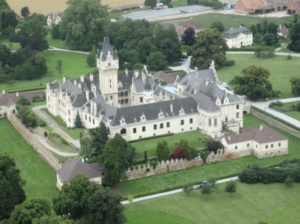
In 1979, when I was twenty, I applied to participate in a masterclass led by Adam Harasiewicz. Mr. Harasiewicz, who is now all but forgotten, won the Chopin Competition in 1955, and the masterclass focused on Chopin interpretation. I had completed my diploma in piano at the Paganini-Conservatorium in Genoa the year before, in 1978, and I was still pursuing a career as a pianist (my first contacts with singers, which led to a change in my goals, i.e., wanting to become a conductor, had started in 1979 and were deepened the next year, 1980, especially through meeting Leyla Gencer and Luciana Serra).
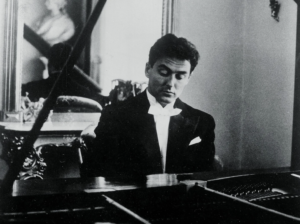
Adam Harasiewicz
The Summer of 1979 was my first experience outside of Italy, aside from studying with Aldo Ciccolini in Orange in 1978, and I was very nervous but also very excited.
Mr. Harasiewicz was very sweet and kind during that Masterclass. By contrast, my (and, in general, all students’) encounters with another teacher at that Masterclass at Schloss Grafenegg, Ms. Halina Czerny-Stefanska (who won the Chopin competition in Warsaw in 1949), were less pleasant and less kind. She was an excellent teacher, but extremely strict.
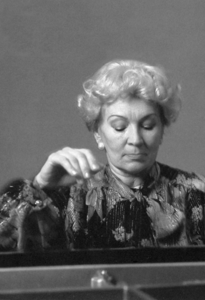
Halina Czerny-Stefanska
I had prepared Chopin’s h-moll Sonata for this course, and I could work on it with both teachers, Mr. Harasiewicz and Ms. Czerny-Stefanska. They, of course, had different, and at times opposing, opinions about its interpretation, but I could benefit musically from both of them. Unfortunately, another participant, a young Japanese girl, had also brought the same piece to the course, and she was without a doubt better than me. Nevertheless, both teachers wanted me to play at the final students’ concert, so I had to prepare something different in a week. I chose Chopin’s g-moll Ballade, but since I had never studied it, I had to practice day and night.
We, the students, all lived in the Grafenegger Schlosstaverne, and the organizer of the Masterclass, the wonderful Dr. Grossberger (together with the Austrian Chopin Society, then led by Dr. Prilisauer), allowed us to study at night in the Castle. We had a key (a real, big old key) to open the main door, and we could practice and play whenever we wanted. A real paradise for pianists.
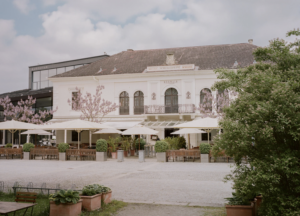
Today, I am at the Grafenegger Schlosstaverne in the very room (Room 7) I stayed in during my 1979 visit. It brings back many beautiful memories: my “former” life as a pianist, many friendships I made during the Masterclass, my first contact with Austria and its musical life – I later spent many years in Austria, studying in Graz and living there, and later in Vienna – and a musical “awakening,” working with great artists and teachers.
At that time, Grafenegg was very isolated, a forgotten castle with a small cultural life. Now, it is one of the major European festivals.
I am fortunate to have experienced Grafenegg at its beginning and now.
February 17, 2026
Kathrin Brunner interviews Fabio Luisi about the Opera “Cardillac” by Paul Hindemith, currently at the Zurich Opera
Fabio Luisi, in Zurich, you’re conducting your third new production of “Cardillac,” following productions in Dresden and Florence. What fascinates you about this piece?
It’s this very unique musical language. “Cardillac” isn’t an opera that draws its power from the drama of the text or the situations. Instead, it’s genuinely a musical opera: the music carries everything; it develops independently. It doesn’t illustrate or explain. Hindemith deliberately moves away from Wagner’s idea of a through-composed music drama, leaning toward older forms. There are clearly self-contained numbers like arias, duets, and scenes with distinct endings. Hindemith works with individual musical blocks, with hardly any motivic references. He emphasizes pure musical form. That’s a clear aesthetic statement. That might sound very abstract. Is this music also emotionally detached? Hindemith actually aimed not to evoke emotions, especially in this opera. In later works, such as “Mathis der Maler,” he moved away from this approach to some extent. In “Cardillac,” he only partly achieved this goal — but I won’t judge him for it. Some of the most beautiful moments in this opera sound distinctly romantic or even impressionistic: the lady’s song, for example, or the duet between daughter and father. The latter is also strictly composed as a fugato… and both sing completely different texts… This, in turn, is influenced by the pre-Wagner era and the tradition of 19th-century Italian opera. Maybe the emotion in this piece is simply conveyed differently through the many rhythmic accents in the score. To me, this rhythm signifies the piece’s modernity and connects it to its era. We are in the 1920s: jazz is spreading across Europe, and you can sense the age of big cities, machines, and railways. These pounding rhythms, along with the instrumentation featuring the saxophone, closely associated with Cardillac’s character, clearly place the piece in the Weimar Republic era, the period between the wars. “Cardillac” is a revolutionary opera. It doesn’t surprise me that the Nazis later had issues with Hindemith.
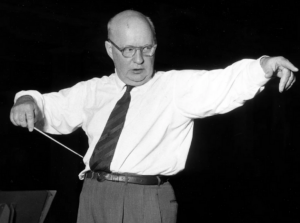
Paul Hindemith
The orchestra in “Cardillac” has an unusual instrumentation. Where does this sonic concept come from?
It has a lot to do with Hindemith’s close relationship with Kurt Weill. The two even co-wrote an opera later, “Lindberghflug.” The “Cardillac” orchestra is relatively small and particularly emphasizes wind instruments—almost like a big band with some strings, plus piano and a lot of percussion. Is there a general mood for you in this score? The story of a murderous goldsmith is inherently dark… There isn’t a single, unified mood here. This is partly because Hindemith mainly links individual lines rather than creating truly expansive soundscapes. However, the low instruments play a key role. The string section alone—six violins and four double basses—is anything but perfectly balanced. Add to that the tuba, bass clarinet, and English horn, all from the bass family. In contrast, brighter colors appear, especially at the end when Cardillac confesses. Suddenly, the flute and piccolo come into play. This feels like a glimpse into Cardillac’s idealized, secluded world, into which no one else is allowed entry. You can definitely hear both the light and dark sides of Cardillac. The other characters are intentionally less individually developed musically. They serve as types, fulfilling specific functions: the daughter or the lady, whose beautiful aria is almost overwhelmed by too much Art Deco, or the cavalier, as an ironic parody of a tenor hero. This latter character, by the way, has nothing to do with a true cavalier but is a reckless daredevil of the worst kind.
A unique feature of this opera is the peculiar love scene between the lady and the cavalier: he presents her with the coveted jewel and is subsequently murdered by Cardillac.
It is a purely instrumental scene in which, as in a silent film, detailed stage directions specify what happens on stage alongside the music. This pantomime—as Hindemith himself calls it—is a magnificent and sometimes ironic moment. It marks Hindemith’s most radical departure from traditional music, drama, and vividly embodies his principle of stylization. The love scene between the lady and the cavalier, which might be sung as a duet in other operas, is here, in a sense, “muted.” Formally, this piece is a kind of canonized divertimento in ABA form. At first, only a few instruments are heard. Two flutes circle each other, lose themselves as if in a labyrinth, and then entwine again. The music, in parallel with increasingly dramatic stage directions, takes on increasingly grotesque qualities until it abruptly halts, almost like a question mark. During the general pause, the murder occurs. The full orchestra returns and crashes into an abyss.
How does Hindemith shape the tonal space in “Cardillac”?
It’s a unique, complex tonal landscape that Hindemith employs in “Cardillac.” He utilizes techniques of multitonality. We see this in the works of Stravinsky and Debussy as well; it’s not revolutionary in itself, but Hindemith makes it highly distinctive. He’s a composer you always recognize immediately; he has an extremely rigorous musical language. He’s often compared to Max Reger. Hindemith himself mentioned Reger, saying he couldn’t imagine his music without him. However, Reger, unlike Hindemith, remains closely tied to late Romanticism—Hindemith is a 20th-century composer. He’s a composer you can instantly recognize; his musical language is very rigorous.
How free is a conductor in such a complex, detailed score as “Cardillac”?
Is there room for interpretation?
I generally avoid using the term “interpretation” in relation to my profession. I see myself as a performing musician; the score is my top priority. Since the form of this opera is very strictly defined, there is limited room for interpretation. However, when the music departs from the “New Objectivity” style, I intentionally allow myself a hint of Romanticism. These deviations are part of this opera—and they need to be made audible.
As a conductor, are you familiar with the “Cardillac” syndrome? You have to detach yourself from your art every night…?
We conductors are not creators but performers. Of course, we add energy, but the work doesn’t belong to us. Still, I understand well when composers or visual artists develop such a close connection with their works that they struggle to let go. I’ve seen this often with several contemporary composers. Some insist on having complete control over the performance. But music only truly comes alive during the performance, not in the composer’s mind. It depends on the musicians’ artistic personalities, who are not machines and don’t just play by the book. It depends on everyone collaborating—the space, the performers, and the audience. Each performance, therefore, creates something new.
December 6, 2025
Why Alexander Zemlinsky’s The Little Mermaid Is Not a Soundtrack
I recently watched an interview with a colleague, a talented and knowledgeable conductor, who claimed that Zemlinsky’s The Little Mermaid was comparable to the works of Korngold, who composed extensive film music during his exile in Hollywood and became known as the first great composer of this genre. The colleague considered Zemlinsky’s symphonic poem to be a predecessor of the modern soundtrack because it depicts every part of Andersen’s fairy tale through music, illustrating each scene.
While I highly respect my colleague, I found this statement very disappointing because I believe Zemlinsky’s The Little Mermaid is the complete opposite of a soundtrack. Of course, a soundtrack can serve as a source of inspiration and help us understand the action of a movie by heightening tension, supporting pacing, or emphasizing characters. Think of Maurice Jarre’s unforgettable music for Doctor Zhivago or Lawrence of Arabia, John Williams’ extraordinary scores for the Star Wars and Harry Potter films, or Hans Zimmer’s music for Gladiator or Interstellar.
Zemlinsky starts from a very different premise. His goal isn’t merely to describe an action or situation but to explain it: like Richard Wagner’s operas, his music not only follows the story but also allows us to enter the emotional world of the Little Mermaid, helping us understand her intentions, motives, and thoughts. In this way, he follows Andersen in his fairy tale: the story isn’t just about tracking a plot but about exploring the protagonist’s inner journey, celebrating her personality and her pursuit of a unique personal identity beyond conventional patterns—the dichotomy of “human” and “non-human,” and the quest for a soul—culminating in her transcending these and ascending to a higher realm.
The Little Mermaid has no name: she searches for one, transcends it, and becomes a spirit of the air.
In this, Zemlinsky, with this masterpiece, does not present us with a precursor to Hollywood soundtracks but with one of the defining achievements of the Wagnerian symphonic poem. In this inward exploration, the outer story or plot serves merely as a pretext. Just as Schönberg takes us into the psychoanalytic depths of Pelléas et Mélisande, and Richard Strauss surprises us with the emotional intimacy and wordless wonder of reaching the summit of a mountain in his Alpensinfonie, Zemlinsky accompanies the Little Mermaid’s search for self by depicting not her actions, but her feelings and sensations, and therein lies his greatness.
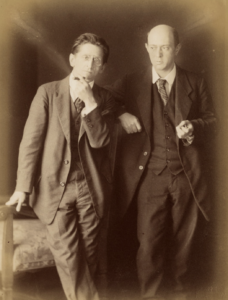
Zemlinsky with Schönberg in Prague, 1917
Perché “La Sirenetta” di Alexander Zemlinsky non è un soundtrack.
Ho visto di recente un’intervista di un collega, direttore d’orchestra, peraltro bravo e preparato, che affermava che “La Sirenetta” di Zemlinsky fosse paragonabile alle opere di Korngold, che durante il suo esilio a Hollywood scrisse molta musica per il cinema, passando alla storia come il primo grande compositore di questo genere.
Il collega considerava Zemlinsky ed il suo poema sinfonico come i predecessori del soundtrack moderno, perché descrive ogni passaggio della favola di Andersen tramite la musica, illustrando ogni scena.
Stimando molto il mio collega, sono rimasto molto deluso da questa sua affermazione, perché ritengo che “La Sirenetta” di Zemlinsky sia esattamente l’opposto di una colonna sonora. Certo, una colonna sonora può essere fonte di ispirazione e può aiutarci a capire le azioni di un film, favorendone o addirittura aumentando la tensione, aiutando il ritmo delle scene o sottolineandone il carattere. Pensiamo alle indimenticabili musiche di Maurice Jarre per “Il Dottor Zhivago” o “Lawrence d’Arabia”, allo straordinario John Williams con i film di “Guerre Stellari” o di “Harry Potter”, o ad Hans Zimmer per “Gladiator” o “Interstellar”.
Zemlinsky parte da un presupposto completamente diverso. Il suo intento non è esclusivamente descrittivo di un’azione o di una situazione, ma esplicativo: come nelle opere di Richard Wagner, la sua musica non ci spiega la trama della favola, ma ci fa entrare nel mondo dei sentimenti della “Sirenetta”, facendoci capire intenzioni, motivi e pensieri.
In questo procede esattamente come Hans Christian Andersen nella sua favola: la storia non è solo il seguire una trama, ma è penetrare nel viaggio interiore della protagonista, esaltandone la personalità e il perseguimento di un’identità personale ed unica, al di fuori da schemi delineati (la dicotomia di “umano” e “non umano”, quindi la ricerca finalizzata ad avere un’anima), che termina con il superamento di questa, assurgendo a una sfera superiore. La Sirenetta non ha un nome proprio: lo cerca e lo supera diventando spirito dell’aria.
In questo, Zemlinsky, con questo suo capolavoro, non ci presenta quindi il prodrome del soundtrack hollywoodiano, ma piuttosto uno dei coronamenti della categoria del poema sinfonico in senso wagneriano: un’esplorazione interiore per la quale l’esteriorità, o se vogliamo, la “storia” o la “trama” è solo pretesto. Come Schönberg ci fa entrare in meandri psicanalitici di “Pelléas et Mélisande”, come Richard Strauss ci sorprende con l’emozione intima e la meraviglia senza parole dell’arrivo in vetta nella sua “Alpensinfonie”, Zemlinsky accompagna la ricerca di sé della Sirenetta descrivendone non le azioni, ma le sensazioni ed i sentimenti, ed in questo sta la sua grandezza.
September 15, 2025
I have, strangely, rarely conducted Mendelssohn’s “Italian” Symphony. Maybe because I have been asked so many times, and I regularly refused. It seemed to me, as an Italian conductor, to be invited to conduct an “Italian” symphony (which, in reality, doesn’t have so much to do with Italy, although Mendelssohn allegedly wrote it after his “Grand Tour” to Italy in 1830 and 1831), a bit of a cliché, like being asked to conduct “Fontane di Roma” or any Respighi, or “Capriccio Italien” by Tchaikowsky. Of course, all these works are great music (with some doubts from my part about “Capriccio Italien”). After a very long hiatus – the last time I conducted Mendelssohn’s Fourth Symphony was in Geneva with the Orchestre de la Suisse Romande in 2000 or 2001 – I accepted the request from the NHK Orchestra in Tokyo. Therefore, this week we will be playing this symphony, together with Beethoven’s Violin Concerto and my first collaboration with María Dueñas, which I am very pleased and excited about.
Of course, I love ALL Mendelssohn, I conducted all his major symphonies (and even some string symphonies), and his great Choral works “Elijah” and “Paulus,” so this is a real pleasure to do the “Italian” symphony with this wonderful orchestra!
April 27, 2025

Since I attended— it must have been 1975 or 1976—my first concert featuring a Mahler symphony (it was the fifth, in Genoa, conducted by Yuri Ahronovitch, a concert I shared with my then-sweetheart, Cinzia, who was one year younger than I am), I consider myself a Mahler addict.My love for this composer has never wavered, and his symphonies have never disappointed me; whether I’m listening to them, studying them, or conducting them (studying his scores repeatedly is one of the most rewarding aspects of my life as a conductor).
These months of April and May are filled with Mahler experiences. In Tokyo, with my NHK orchestra, we are preparing and performing his 3rd and 4th symphonies, which will be presented in a couple of weeks during a European tour, including the Mahler Festival in Amsterdam.
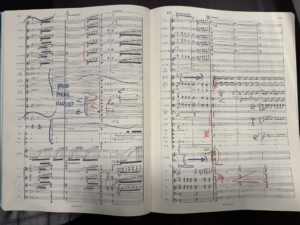
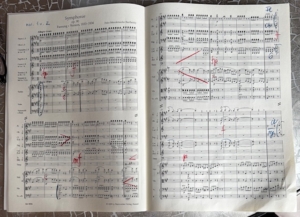
My score of Mahler’s Third Symphony
We are honored to be the first Asian orchestra ever invited to perform there. We are in excellent company: the other orchestras at this festival include the Berliner Philharmoniker, Concertgebouw Orkest, Chicago Symphony, and Budapest Festival Orchestra.
https://mahlerfestival.concertgebouw.nl/en/symphony-no-3-1
https://mahlerfestival.concertgebouw.nl/en/symphony-no-4-and-das-lied-von-der-erde
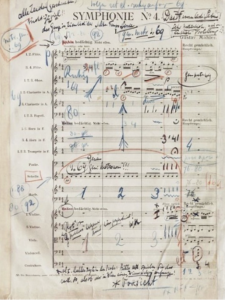
Willem Mengelberg’s score of Mahler’s 4th Symphony, with his and Mahler’s annotations
I will then conduct Mahler’s Second Symphony with the Dallas Symphony Orchestra to close the 2024/25 season, marking a significant milestone in my mission to present all of Mahler’s symphonies during my tenure.
Choosing a favorite among Mahler’s symphonies is challenging, if not impossible. However, the Second Symphony holds a special place in my heart. Having conducted it many times, I appreciate both its grandeur and intimacy (the grandeur naturally leads to the Third Symphony, while the intimacy connects to the Fourth), as well as the unmistakable “Austrian-Bohemian” touch in the Ländler, undoubtedly one of his masterpieces.

Mahler’s manuscript of the Second Symphony
For me, Mahler has always represented a journey of soul exploration. His music delves so profoundly into his (and our) souls that studying (and conducting) it feels akin to an intense therapy session: one emerges cleansed and purified.
March 16, 2025
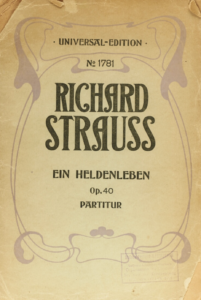
It has been a while since I conducted one of my favorite Richard Strauss works, “Ein Heldenleben” (A hero’s life). I will perform it with the Danish National Symphony Orchestra in Copenhagen next week. Details here.
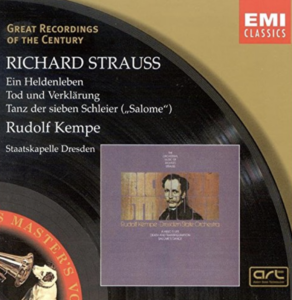
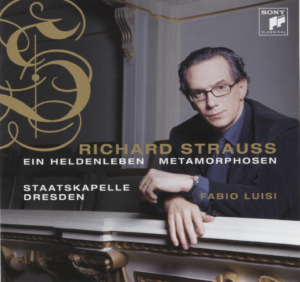
This work is one of my best memories. I first heard it through the glorious, historical, and reference recording by Rudolf Kempe with the Staatskapelle Dresden. Then, I conducted it with many different orchestras and had the privilege of recording it, as Rudolf Kempe’s successor in Dresden, with the great Staatskapelle some years ago. In this recording, I use the ending (which describes the hero’s death) allegedly preferred by Richard Strauss: a soft, comforting, slow ending with a tender violin solo. The usual, most commonly performed ending is the so-called “Zarathustra-Ending” with a full orchestra, giving the work a supplement of empty heroism (spectacular, though). Strauss himself didn’t like this “Zarathustra-Ending”; he defined it as “Staatsbegräbnis” (a State Funeral).
December 24, 2024
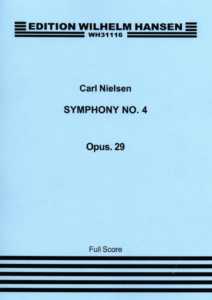
Going on tour with Nielsen’s 4th Symphony.
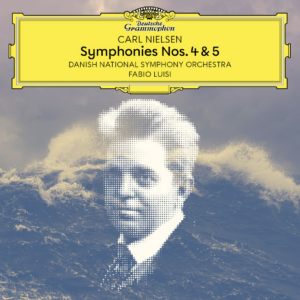
All of Nielsen’s symphonies bring surprises: Nielsen’s very personal language, the instrumentation, the proportions, the courage to break boundaries, the irony, the wit, and the deepness. We find all this in his 4th Symphony, which the Danish National Symphony Orchestra will bring on tour in January under my direction. It started in 2016 with Kim Bohr, the orchestra’s general manager, asking,” Would you conduct Nielsen with us?” I said, “Why not?” although Nielsen was almost unknown to me (I had performed before only his 4th Symphony in Bregenz with my Vienna Symphony Orchestra, but I didn’t remember much of it). My first project was his Second Symphony, and I soon realized that it was me learning from the orchestra rather than the opposite. Those musicians – my musicians – have Nielsen in their DNA, and they were nevertheless surprised about my approach; new to them, probably fresher, more central European, ignoring traditions, and very hardcore towards the text and the pacing of the phrases. We performed all of them and recorded them for Deutsche Grammophon, even winning the Gramophone Prize for best recording of the year 2023. Now, we present this Symphony at some of our tour concerts in different European cities.
Read more about our European tour here.
November 8, 2024

So glücklich wieder bei “meinen” Tonkünstlern in Wien zu sein, noch dazu mit einer meiner geliebten Bruckner Sinfonien. Ich habe so viel von diesem Orchester gelernt, in den Jahren meiner “echten” Ausbildung, vor allem mit Bruckner, ein Komponist der zum DNA aller Wiener Orchester gehört.

September 15, 2024

After a rather long hiatus, I am again going to perform this symphony (with the NHK Symphony Orchestra in Tokyo next week), which I conducted for the first time for my “Kapellmeister-Diplomprüfung” with the Slovenian Philharmonic in Ljubljana in 1983.
There is no point in talking about this symphony, one of the most popular symphonies ever, and rightly so. I was so surprised to hear the “slow” movement (actually an Allegretto in dactylic rhythm, in my personal opinion, a sort of “Trauermarsch,” very much in contrast to the other movements) as a soundtrack in one of the weirdest, and most interesting, movies I know—Zardoz by John Boorman, a 1974 film with Sean Connery and Charlotte Rampling. Once described as “one of the worst movies ever made,” it is now a “cult movie.” And Beethoven is part of it!

September 4, 2024
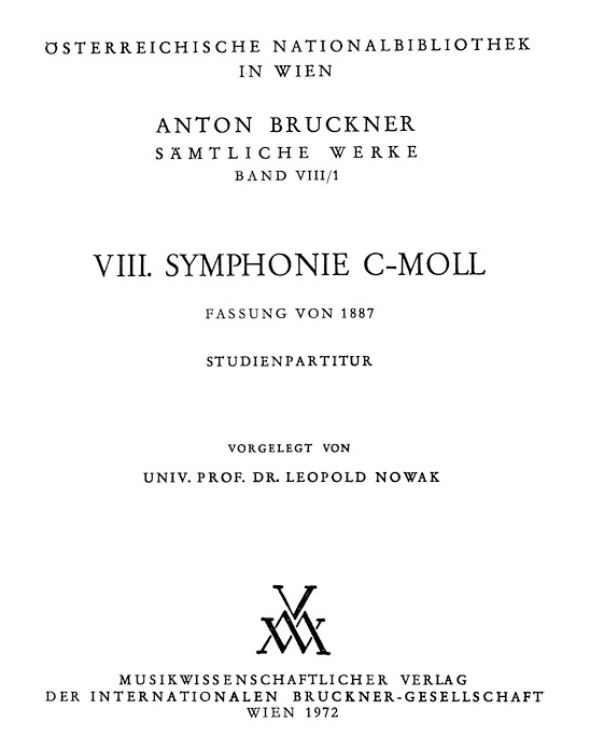
I have conducted and still perform both versions of Bruckner’s Symphony No. 8. The 1887 version (Urfassung) has a longer Adagio, which Bruckner unfortunately cut in the 1890 version. The coda of the first movement in the 1890 version is a beautiful, lyrical, and soft farewell (a different character than the triumphant closing in the first version). Scherzo and Trio are different. Hard choice. However, since I conducted the 1887 version for the first time some 15 years ago, the Adagio in the 1890 version seems to have been “cut” and lacks the proper proportions. Yes, it’s a tough choice. But I don’t want to miss this Adagio of the 1887 version.
Soon, the 1887 version with the NHK Symphony Orchestra in Tokyo.
I also recorded the 1887 version with Philharmonia Zurich.

What I am conductingadmin2025-01-28T11:45:16+01:00