
June 23, 2026
The story of an extortion scam
This story starts on Thursday, June 18. I am traveling very early in the morning from Amsterdam, where I conducted a performance of Simone Boccanegra at the Dutch National Opera the evening before, and I am going home to Switzerland. On that day, I have a couple of appointments, my doctor, and some official meetings at the Community Hall where I live.
On the train from the airport to my home, I see on my phone that I received a message on my Telegram account. I don’t have an official Telegram account; I only have an old one that I rarely use (not at all for a long time). I opened it to join music groups under an unidentified pseudonym, to scroll through other groups, and to participate in discussions, mostly about music, without revealing my identity. As I said, I didn’t use this account for a long time, and I remember receiving login codes I didn’t request from time to time. This happens quite often, and it happened to me, especially about a year ago or a bit longer, when someone impersonated me on social media, claiming to be me and asking for money in exchange for auditions or recommendations.
The message I received was a common extortion scam. I was told to pay 2,000 euros in gift cards to prevent some information from being made public. It didn’t specify what information, but it proposed negotiations and included my full name, Fabio Luisi. I didn’t think much of it and deleted the message without responding. Since I no longer used the Telegram account, I also decided to delete it when I got home. Now I wish I hadn’t done this. This evidence is missing.
On the evening of Thursday, June 18, I traveled to Copenhagen, where the next day I had the final recording session for Arnold Schönberg’s Pelleas und Melisande.
Nothing happened until Saturday afternoon, when I arrived in Amsterdam again for Sunday’s performance. In the taxi to my apartment, I received a WhatsApp message, apparently from a UK number, asking why I had deleted my Telegram account. This time I responded, asking who was asking. The answer was “Bescorts” and included a screenshot of my Telegram account information and a screenshot of a photograph of me, obviously looking at my computer. I asked what that was about, and the person on the other end began talking about a deal I had made with him and broken, involving payment of 5,000 euros, and asked me to negotiate, menacing to contact me and my wife’s agency (why the agency?) in exchange for not reporting me as a pedophile.
This time, I didn’t delete the message immediately. The accusation was too serious, and the fact that this person had either hacked or mirrored my (now non-existent) Telegram account and stolen a photograph of me from my website was a bit too scary. I stopped the conversation, told this person I was going to the police, and blocked the sender. I still have this message on WhatsApp, and I made screenshots.
One hour later, I received a second WhatsApp message, this time from a number in Congo. The sender asked me to unblock him and negotiate. This time, I didn’t engage and blocked the sender. I still have this message and have taken screenshots. It ends with “Unblock me. Let’s negotiate before I ruin your life and career.”
The same evening, I contacted my attorney in Switzerland. She responded immediately, saying it is extremely common to receive this kind of message. The next morning, after consulting with another attorney, she wrote to me again. She told me that going to the police can make sense, but that the police receive hundreds of such complaints and reports, and that, since these scammers are often in Asia or Africa, it is extremely difficult to pursue them. She also said that scammers usually give up after a few days or weeks, and that I should not respond to or engage with them in any way.
The next day, Sunday the 21st, after a successful performance of Simone Boccanegra, I had a longer phone call with her, during which I told her I wanted to go to the police in Switzerland to officially file this report. Should this issue escalate, I don’t want them to tell me, “You should have come to us earlier.” She agreed and offered assistance.
This situation, as everybody can understand, is very serious for me. Being a “public person” is a responsibility, and today, everything said about someone can be amplified and find believers, even if it is not true.
The person behind this extortion scam clearly knows who I am, where I live, and what I do for a living. He has obtained access to my Telegram account (which no longer exists). He refers to a chat that, if it exists, never happened with me, which is either fabricated or conducted with someone posing as me.
On Monday evening, I tried to access my webpage to post content, but couldn’t. I immediately contacted my administrator. After 20 minutes, the page was accessible again, so I thought I was being paranoid… But my administrator confirmed that there had been 11 attempts to access the page (all rejected)…
Let’s see how this story evolves.
There have been no further attempts to hack my website after Monday evening.
As of today, Wednesday, June 24th, there is no crucial development, except that I received a message on my personal X account (which I have not used for at least 15 years) containing an access code I did not request. I don’t know if this is related to this, since I do receive alert messages from time to time from different service accounts (even from Spotify! – please enjoy my Spotify account; there is great music on it!).
At the Police Station (Kantonspolizei)
I was at the Kantonspolizei in Zurich this morning (June 25th). I explained my case and brought all screenshots I had taken of conversations, the phone calls I received, and the attempts to hack my website (including IP addresses from which the attempts were made). I also provided confirmation of the attempt to access my personal X account (now disabled).
The very friendly police officer, Mr. Huber, after examining all the evidence, explained to me that there are hundreds of such extortion scams every week in Switzerland and that my report matches those of thousands of other people. If I have not paid anything (and I have not, of course), it is impossible to go back to the perpetrator. They are mostly in Africa, and they also fabricate fake evidence (AI-generated photos and videos). They can even access computers and phone conversations remotely. He told me I have nothing to fear and that I reacted rightly by not responding and blocking all attempts to contact me. He also told me that he understands that this is very upsetting, but usually, when the victim is not inclined to talk or pay, they move on to the next victim. This is a very common scam, and my scam, the messages, the chats, even the wording of the scammer, follows this scheme.
June 22, 2026
Legato singing, and how to sing consonants
Not many singers can sing real legato. This, unfortunately, is a fact, and in many masterclasses with students and even in rehearsals with professional singers, I have to ask for a real legato. But what is legato (in English: tied) actually? It is the ability to sustain the sound of the vowels in a word without interrupting the flow of sound through the consonants. This brings us to the next problem and to a “trend” in today’s preparation for opera productions.
Many coaches, and, unfortunately, also many conductors, place great importance on articulation. Articulation is, per se, important, but the context needs to be examined. Coaches of the past stressed the fact – as I personally also do – that the sound of the consonants must also be “sung” and not only made through soundless noises. An example of this trend is very current, especially in the German repertoire, where many singers (also some of a glorious past) overarticulate, producing strong, exaggerated gutturals, bilabials, labiodentals, and alveolars, and making all of them plosive (this happens when the flow of the air is blocked and the result is a voiceless sound). The old singing school incorporated consonants into the flow of sound.
My wife Yulia, a coach in Zurich, Salzburg, Amsterdam, Italy, etc., has a good image for the successive consonants so often found in German words: the letters and syllables should be pronounced in a row, and given time and space, not jammed together like a traffic jam, and the consonants should “dance” in the mouth. I think these images are very helpful for understanding the concept, and this is crucial for beautiful legato singing.
But more than an explanation, a singer from the past (and a German one) makes clear how perfect pronunciation and expressive legato can be combined.
It is a joy, as it always is when I hear him sing, to listen to Fritz Wunderlich singing Lenski’s Aria from Tchaikovsky’s Eugen Onegin. I only wish more singers today would listen to such singers of the past; they have a lot to teach.
By the way: Mr. Wunderlich’s “non-acting” is the highest art of acting. With no unnecessary gestures, his simple posture illustrates Lenski’s despair, loneliness, and hopelessness, and the stage behind him, in its simplicity and squalor, helps us understand – without “teaching” us – what is happening in this scene.
About some German singers’ overarticulation (no names here) the great Otto Schenk made a joke, imitating them and saying – in perfect Italian – “si mangia la voce.”
June 19, 2026

Me, waiting for today’s Tina’s online lesson
A sedentary lifestyle, frequent travel, time zone changes, stress, professional and personal pressures: all of these things impact energy and physical and psychological well-being. The passage of time and aging reduce the body’s automatic response, which requires a boost. I’ve always tried to compensate for this with a fitness program, which I included in the hotels I stayed in. A turning point came thanks to Yulia, my wife, who started a program with the amazing Tina Cahova, a personal trainer who comes to my home but also offers fitness classes via FaceTime. Tina is not only excellent at demonstrating exercises, but she tailors them to each person’s needs: Yulia’s series of exercises is different from the one Tina has created and is creating for me. The body immediately feels the benefits of these exercises—and so does the spirit. Thank you, Tina!


Tina in action (more…)
September 10, 2025
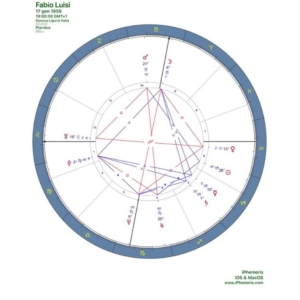
I am interested in astrology, an ancient science, in the sense of what was considered a science in the past centuries. Out of curiosity, I hired a very famous Italian astrologer, Dr. Marco Pesatori, to provide me and my wife, Yulia, with our astrological chart (which, by the way, is Capricorn – Yulia is Pisces).
We also had an interesting discussion about it.
Some of what I learned is that tenacity and discipline are two of the crucial skills of Capricorns. Self-doubt (strong Saturn, alas) and reflection are, in my chart, balanced by a Leo as ascendant… fascinating.
Of course, I hesitate to call astrology a science, but it is nevertheless astonishing how precise some characteristics can be defined through an astrological chart.
In any case, to be continued.
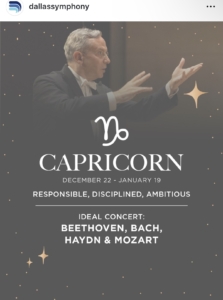
Recently, the Dallas Symphony Orchestra, one of my home orchestras, created an astrology-themed post: The Zodiac Signs as DSO Concerts. My ideal concert, according to their reading? Beethoven, Bach, Haydn, and Mozart. With my moon in Taurus and a Leo rising, I’d make sure that ideal concert has some flair and perhaps some vocal soloists, too. And, indeed, I will conduct a concert with exactly those four composers towards the end of the season with my excellent DSO. Still, Mozart and Beethoven are already on the program in November, with Beethoven’s Egmont Overture and Mozart’s dramatic G Minor Symphony (N. 40).
June 8, 2025
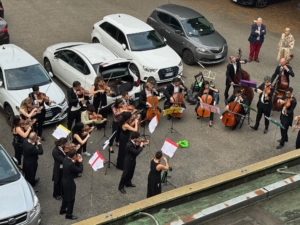
Some musicians of the RAI Orchestra in Turin organized a small outdoor concert in front of the Auditorium Toscanini, right in the car park space. They wanted to attract attention to the Pride Happening on June 7.
This happened just before a concert we played together at the Auditorium (Schubert Unfinished Symphony and Bruckner 7).
A beautiful idea to express their support for LGBT rights. I observed them from my dressing room.
March 24, 2025
A wise man, his wise advice.

My friend and Perfumery-Guru Ron Winnegrad’s blog is a source of wisdom, goodness, and common sense. A Perfume Whisperer‘s last entry is striking in simplicity.
There are two sets of three that are simple directives for good behavior for youngsters, also absolutely for adults. The first set deals with integrity: 1. Never Lie. 2. Never Cheat. 3. Never Steal. The second set of three is how to behave when things don’t work out right: 1. Do not whine. 2. Do not complain. 3. Do not make excuses.
To expand on one’s character and integrity, the youngster and definitely the adults should follow these six suggestions: 1. Be true to yourself. 2. Help others always. 3. Make each day your masterpiece. 4. Drain knowledge from good books. 5. Make friendship a fine art. 6. Pray for guidance and give thanks for your blessings.
Never worry about results, that worry hurts the future. Being concerned about the future you figure out the future solutions. Concern leads to results. Worry leads to lost sleep. If you can’t control your emotions, your emotions will control you. When emotions run the show, you will lose.
Never try to be better than someone else, never cease trying to be the best you can be. That you have control over, not the other. Judge the quality of your success on your effort not on how you compared to others.
Always be open to learn from others. I even learn from my 7 year old neighbor. She says she would like to look like she is a teenager. Yet she has the intelligence and maturity of one in their teens. What a blessing she is to have a conversation with. She educates me.
TAKE CARE, STAY WELL, STAY HEALTHY. HAVE FAITH. THANK YOU.
As an agnostic, I asked Ron for permission to reformulate point 6:
hope always to be able to discern between right and wrong—and always with a bit of doubt, if you think to have been right.Thank you, Ron!
January 25, 2025
We will miss him: David Lynch

My first encounter with David Lynch was “Twin Peaks” in 1990, when I still lived in Graz, Austria. The allure of the mysterious, the idea of a secret everyone knew, but no one spoke about, the “said and unsaid,” and the cinematography were exciting. I remember that we waited for the new episode week after week. Starting from there, the passion became almost an obsession, leading me to discover previous creations, such as Blue Velvet with the wonderful Isabella Rossellini and the extraordinary and disturbing Dennis Hopper, The Elephant Man with John Hurt, and also the film later disavowed by Lynch, Dune, which I still love and also believe to be much closer to Frank Herbert’s novel, and its style, than Denis Villeneuve’s recent adaptation. His masterpiece would come later, the enigmatic Mulholland Drive with the perfect and multifaceted Naomi Watts.
David Lynch was a director and an artist who loved to play not only with the plots of his films or with images; he wanted to play with the viewer’s head, deceiving, diverting, and leading him on unexpected and surprising visual and conceptual paths. No other film director is comparable to him, except perhaps David Cronenberg—naturally with a taste tending towards the macabre and with a more pronounced physicality.
The void left by David Lynch in the world of cinema and art will be difficult to fill.
November 22, 2024


A Viennese total immersion during rehearsals and concerts with the Tonkünstler Orchestra: Kaffeehaus and looking for old books. Breakfast at Bräunerhof (only in Vienna, München and Berlin can you get “Eier im Glas”), concerts at the Musikverein, and good old books in the Annagasse.

October 26, 2024
After a long concert with music by Mozart (two arias with the mezzo Maria Schellenberg, and everybody’s favorite Serenata KV 525) and Skrjabin (the almost unknown Second Symphony), four members of the Danish National Symphony Orchestra entertained a remarkable audience (I counted at least 120 people) with quartet music. Haydn, by the way, one of those marvels among the sixty-eight string quartets he wrote. Those four musicians (four ladies) had just elegantly shaped Mozart’s Serenata for 17 minutes and fought through a tiring, challenging, experimental Skrjabin for 44 more minutes (plus the two arias). Still, they wanted to offer a welcomed “encore” to people who, some with a glass of wine in their hand, others standing behind, already dressed to leave, visibly – and silently – enjoyed the performance.
I also stayed for a while, enjoying the music and thinking that being a musician is truly something special. Those of us who have the chance to make our profession what we have practiced our whole lives (it is the only job for which you start studying as a child) know that music is your best friend, a friend who gives you joy in happy moments and comfort in difficult ones. A friend who never betrays you. And with your best friend, you want to spend time together, even after a long, hard work day.
So, after and despite a long concert, the four ladies offered more music to the smaller audience and themselves for an additional moment of mutual joy and beauty, showing once again that musicians are unique and different.

September 27, 2024

A recent article in The New York Times Magazine brings again to the surface somebody whom we have missed in the last years, partly due to his choice to focus on different things (meditation) and, as we hear, partly because of health issues: David Lynch.
I have always admired David Lynch for his non-mainstream activity as a director and, more generally, as an artist. A specific voice (literally—as explained in the Times article—and metaphorically) in the very diverse panorama of movie directors, his way of understanding cinema, as a medium and as a world of fantasy, has often been imitated but never surpassed, even by today’s cinematic standards.
My very personal list of his masterwork, in order of importance:
- Twin Peaks (the TV series)
- Mulholland Drive
- Blue Velvet
- Dune (even if he repudiated it, is a great movie and very close to Frank Herbert’s novel)
- The Elephant Man
Total Views: 620Daily Views: 1